THE LAST UNICORN

A Christmas essay about a film that stays quiet and still says everything
As a child, I had a Christmas favorite that never felt like a “children’s film”: The Last Unicorn.
No colorful permanent grin. No moral hammer. No manufactured warmth.
Just a soft, shimmering sting.
A fairy tale that doesn’t try to comfort you, but sees you.
Perhaps that is exactly why it belongs to Christmas.
Christmas is not a feeling. It is a space.
Light and expectation at the same time. A date like a mirror.
You stand just in front of it and see things you usually avoid not because you want to heal, but because time itself builds a stage.
Smells, voices, that old laminated feeling in the body.
A quiet suspension between two days.
Nothing has to be evaluated. But the space is there.
The Last Unicorn knows this space.
The unicorn is simply there.
Untouched, not naive, but uncompromising.
In other stories, magic is an escape route. Here, it is a state.
A color that remains, even when you close your eyes.
And by simply existing, other things come into sharper focus:
greed, fear, longing, the shame of human compromises.
King Haggard does not want to own. He wants to feel. But he cannot.
His castle is not a home, but a museum of suppressed sensation.
Nothing living is allowed to breathe. He built perfection so that he would no longer have to feel anything.
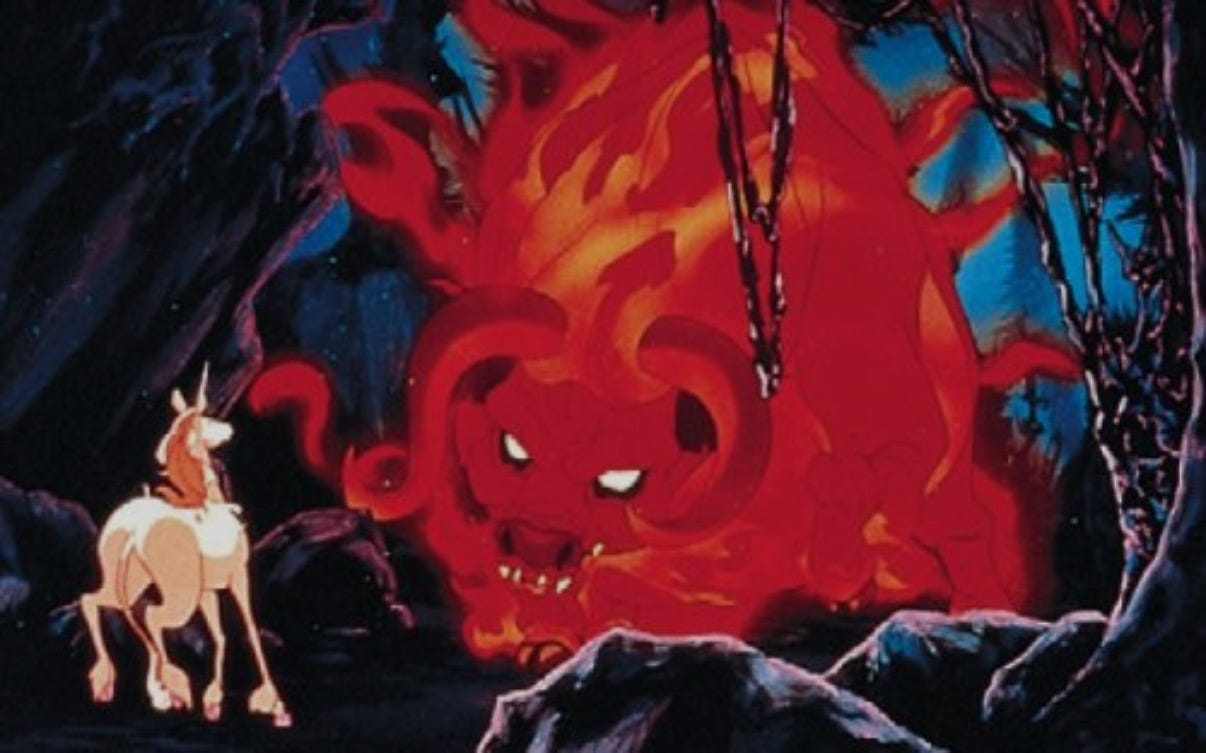
The Red Bull explains nothing. He pushes.
The world rarely changes through insight, but through pressure.
Something disappears because something else takes up space. Like time. Like systems.
The unicorn does not run because it has been convinced. It runs because it must.
Molly Grue is truth without gloss.
A woman who arrived too late to still believe in fairy tales
and therefore knows how much hope can hurt.
Her encounter with the unicorn is not a gift.
It is a wound that glows.
You can see something beautiful and mourn everything that never came.
Schmendrick casts spells halfway and fails halfway.
Comedy as a survival form. Laughter out of overwhelm.
Perhaps he is the most human of all, because he senses how large the world is
and does not know where to put that knowledge.
At the center is transformation. And it hurts.
The unicorn becomes human, and suddenly time begins.
Shame. Fear. Desire. That sticky, tender chaos called humanity.
Transformation is not a happy ending. It is the loss of a form.
Perhaps one has to become mortal for that.
Perhaps one even wants to.
Because only then is closeness possible.
Christmas sometimes feels exactly like this.
Not romantic. But true.
A place where everything shines and yet something is missing.
Not like pain, but like memory.
Like a draft under the door, a small flicker between being and having been.
I did not want to write a text about healing.
No moral. No answer.
Just standing still and seeing.
When I watch The Last Unicorn today, it is not nostalgia.
It is like an old color that still glows deep underneath,
long after it has been painted over.
Like blue light behind closed eyelids.
Samu
oh wow this is quiet in the way that knows it doesn’t need to raise its voice. I love how you frame Christmas as a space, not a mood~ that alone made me pause. everything here feels like it’s standing very still and letting the truth walk up on its own. Molly Grue especially… “a wound that glows” is such a perfect way to say loving something too late. and that ending image, the old color under layers of paint? yeah. that stayed with me. this isn’t explaining the film… it’s sitting beside it and breathing. really beautiful.
💙”Blue light from my closed eyelids. “
Love this>>>
Christmas is not a feeling. It is a space.